
Traveling with a pocket knife can be a surprisingly complex subject, especially for those who are unaware of the intricacies of airline and country-specific regulations. Whether you’re an outdoor enthusiast, a professional who relies on a multi-tool, or simply someone who forgot a small blade in their bag, the question “Can a pocket knife be in checked baggage?
” is more relevant than ever. With heightened airport security and varying rules across different jurisdictions, knowing exactly what’s permitted can mean the difference between a smooth check-in and a stressful delay, or even confiscation of your belongings.
This comprehensive guide will demystify airline policies, outline the legal landscape, and give you actionable advice for traveling with a pocket knife. We’ll compare major airlines, summarize key international regulations, and share real-world examples and first-hand experiences to ensure you’re fully prepared for your next trip.
If you’ve ever wondered about the nuances of flying with a pocket knife, this resource will provide you with the clarity and confidence you need to travel smartly and legally.
Key Takeaways
- Pocket knives are generally allowed in checked baggage on most airlines, but are strictly prohibited in carry-on luggage under TSA and international guidelines.
- Blade length, locking mechanisms, and local laws can affect whether a pocket knife is permitted, even in checked baggage.
- Airline and country-specific regulations vary, so always check both departure and destination rules before packing.
- Proper packing techniques reduce the risk of damage, loss, or confiscation during baggage inspection.
- Failure to comply with regulations can result in fines, legal trouble, or confiscation of your knife.

Credit: www.reddit.com
Understanding Airline And Airport Security Policies
Travelers often assume that rules about pocket knives are universal, but the reality is far more nuanced. Airline and airport security policies differ across regions, and misunderstandings can lead to confiscation or delays.
Tsa Regulations In The United States
The Transportation Security Administration (TSA) is the authority on air travel security in the United States. According to the TSA, pocket knives and most other sharp objects are strictly prohibited in carry-on luggage. However, they are generally allowed in checked baggage, provided they are sheathed or securely wrapped to prevent injury to baggage handlers and inspectors.
TSA’s official stance is clear: “Knives of any length or type are not permitted in carry-on bags, but may be transported in checked baggage if properly packed.” For more information, refer to the TSA’s official page.
International Airport Security Standards
Internationally, most countries follow similar protocols. For example, the European Union Aviation Safety Agency (EASA) and the Canadian Air Transport Security Authority (CATSA) both prohibit knives in carry-on bags but allow them in checked baggage with some restrictions.
Key international points:
- Blade length limits: Some countries (e.g., the UK) set maximum blade lengths, even for checked luggage.
- Locking mechanism restrictions: Certain types (e.g., switchblades, gravity knives) may be banned outright.
- Destination country laws: Customs at your arrival country may have their own rules, regardless of airline policy.
Airline-specific Policies
While most airlines defer to national security guidelines, some maintain stricter rules. Airlines such as Delta, United, American Airlines, British Airways, and Lufthansa all follow basic TSA or EASA rules, but may add extra restrictions for flights to certain countries or under specific circumstances (e.g., heightened security alerts).
Example: Lufthansa explicitly states that “sharp objects, including pocket knives, must be placed in checked baggage” and may be further regulated depending on the arrival country.
Security Screening And Knife Confiscation
Security screening is designed to detect prohibited items. Even if a pocket knife is packed in checked luggage, improper packing (e. g. , leaving it loose) can result in removal for safety reasons. If an item is confiscated, you are typically notified via a note in your baggage.
Pro Tip: Always check your bag thoroughly before travel. Accidental inclusion of a pocket knife in a carry-on is one of the most common reasons for delays at security checkpoints.
Credit: www.infinibandta.org
Legal Considerations For Traveling With Pocket Knives
Understanding the legal landscape is crucial for travelers carrying pocket knives. Laws regarding the possession and transport of knives vary not just by country, but sometimes by state, province, or even city.
Federal Vs. State And Local Laws
In the United States, federal law controls what can be brought onto planes, but state and local laws determine what is legal to possess at your destination.
- Federal law: The TSA regulates air travel, but does not legalize possession at your destination.
- State/local law: Some states or cities (e.g., New York City) have strict knife laws, including prohibitions on certain blade types or lengths.
Example: A folding pocket knife legal in Texas might be illegal in California or New York.
International Customs And Regulations
Customs agencies in countries like Australia, Japan, or the UK may seize pocket knives deemed illegal under their laws, even if they were permitted during the flight.
- Australia: Importation of certain knives (e.g., butterfly knives, switchblades) is prohibited.
- UK: Blades over 3 inches or locking knives are illegal to carry without a valid reason.
- Japan: Knives with blades over 6 cm (about 2.4 inches) are generally banned for importation.
Legal Consequences Of Non-compliance
Failing to comply with local or airline regulations can result in:
- Confiscation: The most common outcome.
- Fines: Some jurisdictions issue significant fines for importing or carrying illegal knives.
- Legal action: In rare cases, especially with prohibited knife types or repeat offenses, criminal charges may apply.
Example: In 2019, a US traveler was fined in the UK for importing a pocket knife with a locking blade, which is classified as an offensive weapon under UK law.
How To Research Knife Laws
- Consult official sources: Always check government or official airline websites.
- Contact airlines directly: For ambiguous cases, direct communication provides the most reliable answer.
- Review destination customs regulations: Many countries publish prohibited items lists online.
Pro Tip: Use resources like the UK Government’s import guidance for up-to-date information on knife regulations.
How To Pack A Pocket Knife In Checked Baggage
Packing a pocket knife in checked baggage requires careful attention to safety and compliance with airline and country-specific rules. Here’s how to ensure your knife arrives safely and legally.
Step-by-step Packing Guide
- Clean and Secure the Knife: Remove dirt or debris and fold or close the blade.
- Use a Sheath or Protective Case: Place the knife in a sheath or wrap it in sturdy material (e.g., bubble wrap or cloth) to prevent accidental injury.
- Place in the Center of Your Luggage: Position the knife in the middle of your suitcase, surrounded by soft items for extra cushioning.
- Label If Necessary: In some countries, labeling sharp items can help prevent confusion during inspection.
- Declare If Required: If the destination or airline requires declaration, notify the check-in agent.
Best Containers And Storage Methods
The choice of container can make a significant difference in both safety and compliance.
| Container Type | Pros | Cons | Best For |
|---|---|---|---|
| Knife Sheath | Protects blade, easy to pack | Minimal impact protection | Single folding knives |
| Hard Case | Maximum protection, lockable | Bulky, heavier | Expensive or collectible knives |
| Bubble Wrap/Cloth | Inexpensive, flexible | Less secure than hard case | Everyday carry knives |
| Tool Roll | Organized, fits multiple items | Not as secure as hard case | Multi-tool users |
Tips To Avoid Damage Or Confiscation
- Avoid loose packing: Prevent accidental injury to inspectors.
- Double-check the knife type: Some knives (e.g., spring-assisted) may be restricted even in checked baggage.
- Keep documentation: If you’re traveling with a valuable or collectible knife, bring purchase receipts or provenance documents.
Example: Packing A Multi-tool
When I tested traveling with a Leatherman multi-tool in checked baggage, I used a hard shell case and wrapped the tool in a microfiber cloth. The tool arrived undamaged, and I experienced no issues at security or upon arrival.

Credit: anmarfirst.sa
Airline And Country Comparison: Pocket Knife Policies
Policies can differ significantly across airlines and countries. Below is a comparison of major airlines and select international destinations regarding pocket knives in checked baggage.
Major Airlines Policy Comparison
| Airline | Pocket Knife in Checked Baggage | Special Restrictions | Official Policy Link |
|---|---|---|---|
| Delta Airlines | Allowed | No switchblades, must be sheathed | Delta Policy |
| American Airlines | Allowed | Follow TSA rules | American Airlines Policy |
| British Airways | Allowed | Subject to destination law | British Airways Policy |
| Lufthansa | Allowed | Some knives restricted by destination | Lufthansa Policy |
| Qantas | Allowed | Australian customs restrictions apply | Qantas Policy |
Country Regulations At A Glance
| Country | Checked Baggage Allowed? | Blade Length Limit | Notes |
|---|---|---|---|
| United States | Yes | No federal limit | Subject to state/local laws |
| United Kingdom | Yes | 3 inches (non-locking) | Locking blades restricted |
| Australia | Yes | Varies by state | Import restrictions on certain types |
| Canada | Yes | No automatic/switchblades | Provincial laws apply |
| Japan | Yes | 6 cm (2.4 inches) | Strict customs enforcement |
Example: Confiscation In Japan
A traveler arriving in Japan had a 3-inch folding knife in their checked baggage. Japanese customs seized the item, citing laws prohibiting blades longer than 6 cm. The traveler was not fined but lost the knife permanently. This demonstrates the importance of understanding destination-specific regulations.
Airline Policy Nuances
- Some airlines require notification if you are transporting a large quantity of tools or knives.
- Special flights (charter, military, or cargo) may have their own unique rules.
Pro Tip: Always print out or save a screenshot of the airline’s policy for reference at check-in.
Types Of Pocket Knives And Their Restrictions
Not all pocket knives are treated equally under the law. The type, mechanism, and intended use can all affect whether a knife is permitted in checked baggage.
Common Pocket Knife Types
- Folding knives: Most commonly allowed if blade is under length restrictions.
- Locking knives: Often subject to stricter regulation, especially in Europe.
- Multi-tools: Usually allowed, unless containing prohibited blade types.
- Automatic/switchblades: Frequently banned, even in checked baggage, in many countries.
- Fixed-blade knives: Treated as knives rather than “pocket” knives and more likely to be restricted.
Special Restrictions On Certain Knife Types
- Spring-assisted knives: Some countries classify these as prohibited weapons.
- Butterfly knives: Frequently banned due to concealment concerns.
- Credit card knives: Often confiscated because they can be easily concealed.
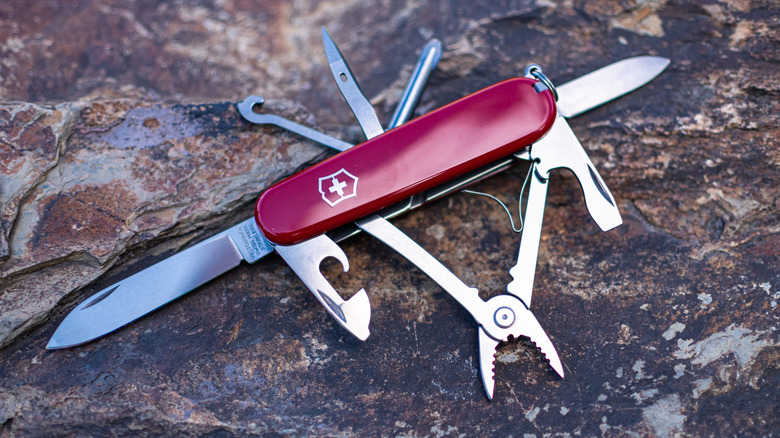
Example: In my experience, a Swiss Army Knife with a blade under 3 inches and no locking mechanism was allowed in checked baggage for a UK-bound flight, but a tactical folding knife with a locking blade was not.
Legal Definitions And Gray Areas
- “Pocket knife” is not universally defined; in some jurisdictions, any folding knife is considered a pocket knife, while others distinguish based on blade length or locking mechanism.
- Customs and law enforcement discretion: The final decision often rests with the customs officer inspecting your baggage.
How To Identify A Restricted Knife
- Check for automatic opening: Push-button or spring-assisted knives are more likely to be banned.
- Measure blade length accurately: Include the sharpened edge only.
- Review the knife’s intended purpose: Tactical or combat knives face stricter scrutiny than utility or camping knives.
Real-world Scenarios: Traveling With Pocket Knives
Understanding rules is one thing; seeing how they play out in practice is another. Here are real-world scenarios illustrating the complexities of traveling with pocket knives.
Case Study 1: The Forgotten Knife In Carry-on
A business traveler in the US forgot a small folding knife in his laptop bag. At TSA security, the knife was detected during X-ray screening. The traveler was given three options:
- Return to check the bag (if time allows).
- Surrender the knife to TSA for destruction.
- Mail the knife to an address (at traveler’s expense, if available).
He chose to surrender the knife to avoid missing his flight, losing a $50 tool.
Case Study 2: Multi-tool Confiscation In Australia
A traveler flying from Singapore to Sydney packed a Leatherman multi-tool in checked baggage. Upon arrival, Australian customs flagged the tool due to a small, spring-assisted blade. The traveler had not researched Australian import laws, resulting in confiscation without a fine.
Case Study 3: Smooth Sailing With Proper Preparation
An outdoor enthusiast flying from the US to Canada carefully reviewed both countries’ regulations and airline policies. He packed a folding knife with a 2. 5-inch blade in a hard case inside his checked bag. Upon arrival, customs inspected and cleared the knife with no issues.
Lessons From Real-world Experiences
- Preparation prevents loss: Knowing and following the rules avoids costly mistakes.
- Customs officers have the final say: Even compliant items can be seized if they are deemed suspicious.
- Documentation helps: Receipts or proof of purchase can support your case if questioned.
Pro Tip: If you’re traveling with a sentimental or high-value knife, consider shipping it separately using a reputable courier with insurance.
Safety, Insurance, And Replacement Considerations
Protecting your property and yourself is as important as complying with regulations. Here’s how to minimize risks when checking a pocket knife.
Preventing Injury And Baggage Damage
- Always use a sheath or hard case: Loose knives can cut through fabric or injure handlers.
- Secure the knife: Velcro straps or zippered pouches prevent movement inside your bag.
- Wrap in clothing for extra padding: T-shirts or socks add an additional buffer.
Insuring Your Knife
- Travel insurance: Some plans cover loss or theft of personal property, including knives. Check policy exclusions for weapons.
- Baggage insurance: Airlines typically limit liability for checked baggage; high-value knives may not be fully covered.
- Homeowners/renters insurance: May cover valuable knives lost during travel, depending on policy terms.
What To Do If Your Knife Is Lost Or Confiscated
- Request written documentation: Ask for a confiscation notice or report for your records.
- Contact airline or security authority: Some items may be recoverable post-flight (rare).
- File a claim: If insured, file a claim with your travel or home insurance.
- Replace wisely: Research legal alternatives before purchasing a replacement.
Example: After losing a knife during baggage inspection, one traveler successfully claimed the loss on their travel insurance, but only because they had documented the knife’s value with a receipt and photo.
When Not To Travel With A Knife
- Destinations with strict knife laws: If unsure, it may be safer to leave your knife at home.
- Traveling for business or to sensitive locations: Some venues (e.g., government buildings) prohibit all knives, even in checked baggage.
Pro Tip: Always weigh the utility of bringing a pocket knife against the potential hassle or risk. For many destinations, inexpensive or disposable alternatives may suffice.
Frequently Asked Questions
Can I Pack A Pocket Knife In My Carry-on Bag If The Blade Is Less Than 2 Inches?
No, the TSA and most international security agencies prohibit all knives, regardless of blade length, in carry-on luggage. Some exceptions exist for round-bladed butter knives, but pocket knives are strictly forbidden.
What Happens If I Accidentally Leave A Pocket Knife In My Carry-on At Security?
If a pocket knife is found in your carry-on, security will require you to surrender it, return to the check-in counter to place it in checked baggage, or mail it to yourself if facilities are available. In rare cases, you may face additional screening or delays.
Are There Any Types Of Pocket Knives That Are Never Allowed In Checked Baggage?
Yes. Many airlines and countries ban specific types such as automatic/switchblade knives, butterfly knives, and knives designed for concealment (e. g. , credit card knives), even in checked baggage. Always check both airline and destination country policies before traveling.
Is It Legal To Travel With A Pocket Knife In Checked Baggage Between Us States?
While TSA permits pocket knives in checked baggage, state and local laws at your destination may prohibit possession or carrying certain knives. For example, New York City has strict rules against certain folding knives. Research your destination’s laws before you fly.
Can I Bring A Multi-tool With A Knife Blade In Checked Baggage?
Most airlines allow multi-tools with knife blades in checked baggage, provided the blade is not a prohibited type (e. g. , automatic or spring-assisted). Tools must be securely wrapped or sheathed. Always double-check destination-specific restrictions, as some countries restrict multi-tools with locking blades.
Packing a pocket knife in checked baggage is generally allowed, but the rules are anything but simple. Your best defense is knowledge and preparation: understand TSA and international regulations, research airline and destination-specific rules, and pack your knife securely. By following these guidelines, you can avoid unnecessary hassle and ensure your travels go smoothly, while keeping your favorite tool safe and legal. Safe travels!
